

Understanding the Xinjitushuo: mapping consciousness
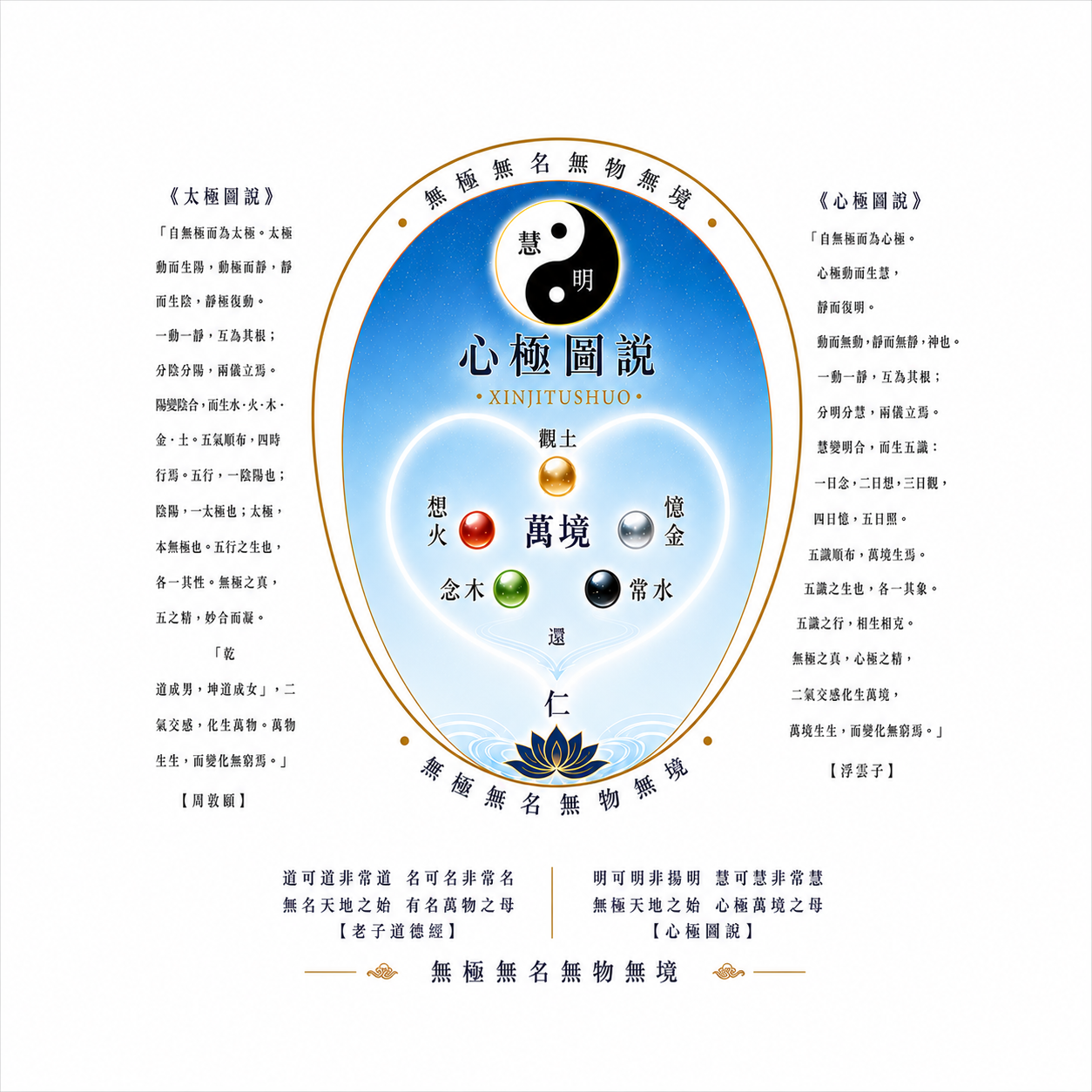
Discover the Xinjitushuo (心極圖說), a first-person phenomenological ontology that reveals how consciousness differentiates, stabilises, and releases. This profound framework offers a unique perspective on lived experience, tracing the generative and regulating cycles of five core cognitions: arising, expansion, centering observation, retention, and illumination.
For contemplative practitioners and scholars
The Xinjitushuo provides a structured, first-person language for inward observation, guiding you through the subtle processes of your mind. For scholars in philosophy of mind and cognitive science, it offers a rigorous alternative to reductive neuroscience, rooted in Asian phenomenology. Explore its concepts to deepen your contemplative practice or expand your academic understanding.

Insights for ritual and care practitioners
For ritual practitioners, caregivers, and family members involved with the Rite of Return, the Xinjitushuo illuminates the cognitive architecture underpinning your practices. Understand how attention stabilises grief and how consciousness transforms through the dying process, recognising these profound shifts within your own experience.

Unique perspectives and practical application
Unlike other frameworks, the Xinjitushuo offers a classical Chinese cosmological diagram transposed into first-person phenomenology, mapping the generative logic of consciousness itself. It provides a diagnostic vocabulary for cognitive disorder that is neither medicalised nor moralised, allowing you to recognise mental process stalls without judgment. Discover the recursive mathematical logic underlying contemplative structure, offering a precise way to understand and navigate your inner world. We encourage you to test the five cognitions in your own first-person experience: observe a thought arising (念), expanding (想), centering through observation (觀), stabilising into memory (憶), and finally releasing into clarity (照). Notice where the cycle interrupts and whether restoring 觀 restores flow.
Create Your Own Website With Webador